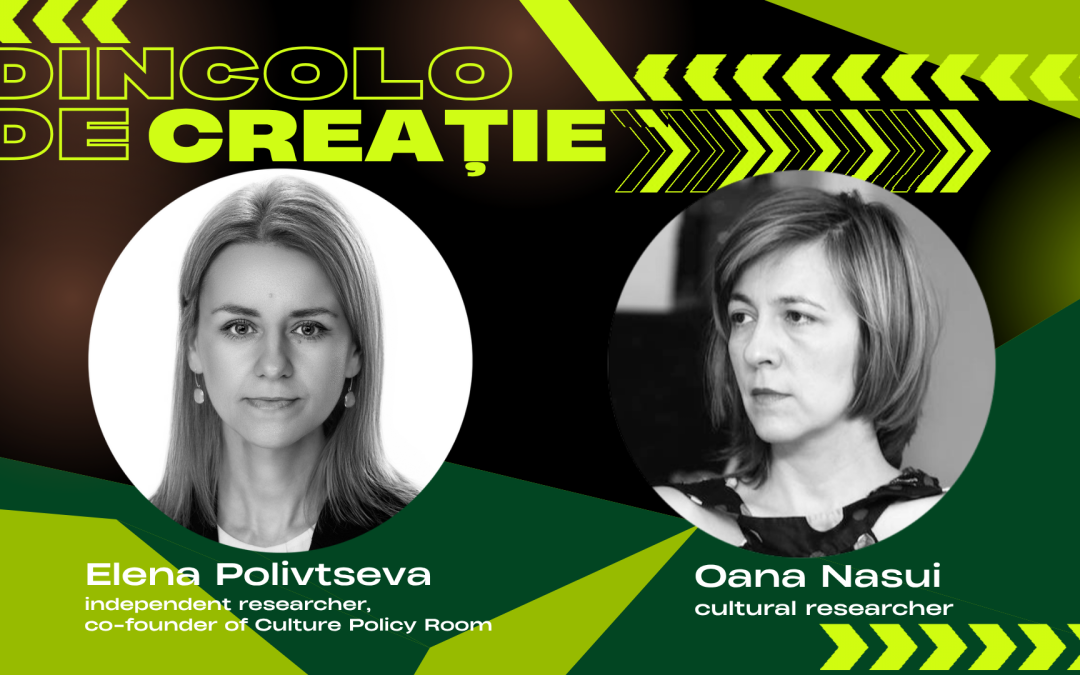
This knowledge transfer interview, part of the “Beyond Creation” project produced by Formare Culturala platform, features Elena Polivtseva (independent researcher and co-founder of Culture Policy Room) in conversation with cultural researcher Oana Nasui (cultural researcher from Romania), exploring key challenges in European cultural policy, from the status of the artist to funding mechanisms and the future of EU cultural programs.
The discussion examines the complexities of contemporary cultural policy in Europe, from establishing independent research spaces free from sectoral agendas to analyzing diverse national frameworks for artist status, the precarious political positioning of culture within the new Agora EU financial mechanism, the risks of merging cultural programs with democracy and civic values initiatives, and the fundamental question of how to advocate for culture as an essential public good with long-term societal impact rather than justifying it solely through immediate economic or instrumental benefits.
Introducing Culture Policy Room
Elena explains that Culture Policy Room is a think tank founded just over a year ago, offering a holistic perspective on European cultural policies. The initiative seeks to identify unexplored topics and provide independent analysis without specific sectoral agendas. Elena emphasizes the need for a space for honest conversations about what works and what doesn’t in cultural policy, as well as the importance of working in a non-programmatic way to respond quickly to emerging topics.
Oana observes the limitations imposed by traditional funding, where everything must be planned in advance with no room for flexibility.
Status of the Artist
Elena contextualizes how the pandemic transformed the discussion about the status of the artist from a marginal subject into a priority. The crisis highlighted the risk of a talent drain from the cultural sector. Between 2020-2023, the European Parliament published three important documents on this topic.
Elena details the diversity of national approaches: some countries focus on filling gaps (access to social security, irregular income), others on rewarding artistic success. Spain, Portugal, and Romania have adopted new laws regarding cultural professionals. Ireland has basic income schemes for artists, Belgium has implemented recent reforms.
Oana intervenes with Romania’s pandemic experience, when authorities faced the fundamental question: “who are the artists and how do we identify them?”. She mentions that the law on cultural workers exists but is not fully operational, with an ambiguous registry and unclear contract types.
The EU’s Role in the Status of the Artist
Oana asks directly what the EU can do in this complex domain that touches on education, taxation, social security, and different types of employment.
Elena responds pragmatically that the EU has limited capacity and cannot impose a universal law. She emphasizes that laws alone don’t solve everything – the example of paternity leave shows that the existence of a right doesn’t guarantee its use. The problem is cultural and requires constant promotion, awareness-raising, and mindset change.
Elena argues that the EU can keep the dialogue open, identify good practices, stimulate exchange of experience, and create structured monitoring mechanisms. She discusses the proposal for a charter on working conditions at European level – even if it seems symbolic, it could trigger progress at national level if it comes with follow-up mechanisms.
Elena uses the example of Berlin’s fair pay fund, recently scrapped due to budget cuts, to illustrate the fragility of progress in this area.
The “State of Culture” Research
Oana asks Elena to present the “State of Culture” report and its research methodology.
Elena first clarifies that for her, culture means the cultural sector – the system of artworks, processes, cultural products, organizations, and professionals – not a vague concept extended to general behaviors and values.
For the report, Elena spoke with representatives of different sectors (arts education, performing arts, music, heritage, audiovisual industry) asking them: “What are the three main challenges for your sector in the next 3-5 years?”. A survey with open fields revealed the sector’s frustration with the instrumentalization of culture – which is why the first chapter focuses on this classic but still unresolved issue.
Elena acknowledges that the report doesn’t claim to be exhaustive, but rather to highlight what is urgent, emerging, and insufficiently discussed.
European Funding – Agora EU
Oana directs the discussion toward the new multiannual financial framework and the merger of Creative Europe with the civic values program into the new Agora EU.
Elena presents in detail the European Commission’s proposal: reduction from 52 to 16 programs, doubling of Creative Europe and CERF budgets within the new Agora EU. She identifies two major problems:
The political problem: Culture no longer has a clearly branded program, becoming politically vulnerable. Although the budget is doubled now, in the future it would be much easier to eliminate or dramatically reduce culture when it no longer exists as a separate program. She exemplifies with national cases where culture was marginalized when merged with other ministerial domains.
The financial problem: The new flexibility mechanism allows transfer of funds between different components (culture, media, civil society, journalism) on an annual basis. Without clear percentages established in the regulation (as exist in the current Creative Europe), there will be constant renegotiation and competition between beneficiaries.
Elena underlines the danger of being neighbors with “democracy” – a current major EU priority – mentioned in the State of the Union speech. Culture doesn’t have the same political importance and risks being marginalized in favor of priorities related to disinformation and protecting democracy.
Culture as Public Good vs. Instrumentalization
Oana raises a question of principle about how we want culture: integrated into all domains or a distinct specific domain.
Elena responds that we want both, but we must be careful how we use the arguments. She differentiates between two approaches:
-Culture as a fundamental public good for a healthy society (accessible to all, diverse expressions)
-Instrumentalization: an artist in every hospital, measuring the cultural impact of every artistic project
She uses the analogy with education: nobody begins justifying a school with its contribution to GDP, but with the necessity of education as a fundamental right. Then, as a secondary effect, come the economic benefits.
Elena warns that abandoning certain sectors (theater, performing arts) will affect the entire cultural ecosystem, because all sectors are interdependent. Some cultural benefits can only be measured over centuries (European cultural identity, understanding history through culture).
Practically, Elena advocates for: first ensuring a solid, guaranteed European cultural program with sufficient budget that protects artistic freedom; then, as a secondary priority, mainstreaming culture into other funds. But this mainstreaming must not divert attention from the main cultural fund and must remain accessible for small artistic organizations from remote areas.
Resources
Between 2020 and 2023, the European Parliament issued three key documents on working conditions in the cultural sector: the 2020 resolution on the ‘cultural recovery’ of Europe, which proposed a European framework for artist status and emphasized monitoring progress on working conditions; the 2021 resolution on the situation of artists and post-COVID-19 cultural recovery in the EU; and most substantially, the November 2023 resolution with recommendations to the Commission on an EU framework for the social and professional situation of artists and workers in the cultural and creative sectors (2023/2051(INL)), drafted by MEPs Antonius Manders (EPP) and Domènec Ruiz Devesa (S&D) and adopted with 433 votes in favor, 100 against, and 99 abstentions.


